Services
Evaluations
Evaluations provide information so you can better understand your child’s needs. Evaluations are necessary to determine if a speech/language impairment is present, develop a treatment plan for your child, and to begin therapy. If you already have an evaluation or IEP from a different provider, you do not need another evaluation to begin services.
*There is currently no waitlist for evaluations.
-
Is your child difficult to understand? Do you notice frustration when they attempt to communicate with you? What about leaving off sounds or substituting sounds? It’s possible your child may have an articulation or phonological impairment; or it may be developmental! An evaluation will help determine which sounds your child needs help with to improve their intelligibility.
-
Language impairments can be complex. You may notice your child having difficulty following basic directions, understanding social cues from adults or peers, communicating his/her wants and needs, being able to understand and ask WH-questions, difficulty with reading comprehension, or providing age-appropriate utterances. These are just a few examples. An evaluation will provide a more detailed analysis of which areas of language your child is specifically struggling with.
-
Fluency encompasses disorders such as stuttering. You may notice your child’s speech isn’t “flowing” the way it should. Maybe you observe excessive pausing, drawing out of sounds/words, a fast rate of speech, or repeating sounds or words frequently. If your child is resistant to speak in specific settings, that could be another indicator. Feelings can be HUGE part of a fluency disorder. An evaluation will help the clinician to determine the best route for treatment; as each child’s needs are individual.
Therapy
Therapy services offered include both in-person and teletherapy options. From language deficits to fluency disorders, I partner with parents to help your child discover their best means of communication. Therapy is individualized for each child, and parents receive additional resources so that they can better understand what their child is working on and how to help them outside of therapy.
AAC Evaluations
If your child is nonverbal or has difficulty speaking, Augmentative and Alternative Communication devices may help your child find their best way to communicate.
-
Practically speaking, Alternative and Augmentative Communication (AAC) are ways to provide alternatives when speech is not functional or to help (augment) speech when it is limited or absent.
These methods can range from low-tech (picture boards) to high tech (devices/tablets).
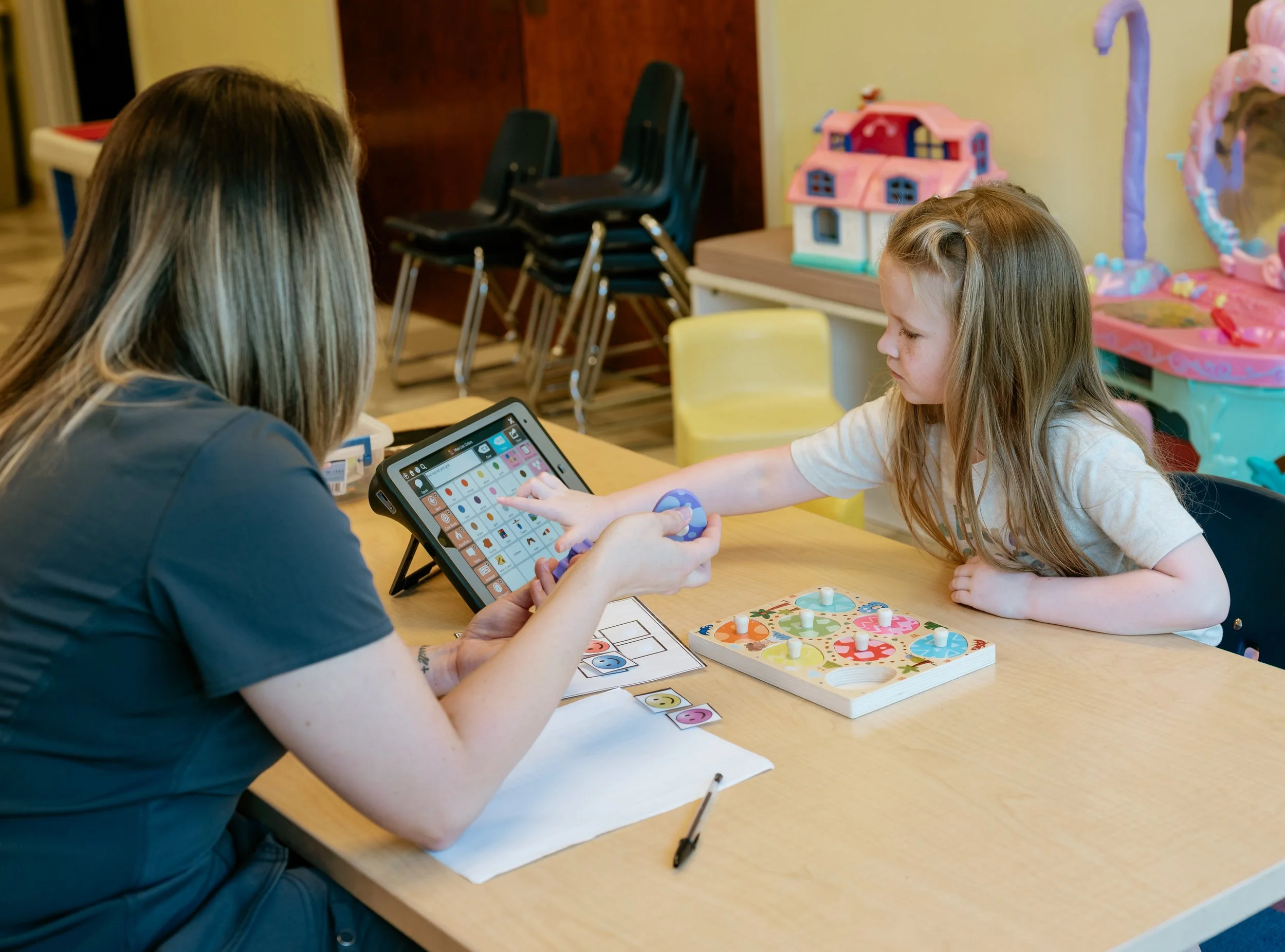
For example, if your child is nonverbal, they may use a device which allows them to point to a picture on a device, and then the device will speak that word out loud.
To learn more about AAC, visit the American Speech-Language-Hearing Association’s page on AAC.
-
There are many AAC devices that can be used. From low tech devices that require pointing or gestures, to high tech devices that require use of a tablet.
At Joyful Sounds Therapy, we will work with you to find the right device for you and your family.
-
As part of our evaluation process, we’ll discuss the benefits of AAC devices and the situations and diagnoses for which they’re appropriate. If traditional methods of communication (such as speech or sign language) have not worked, AAC devices may be a great alternative.